Calgary’s spring weather can shift from calm to severe in a matter of hours. On Friday, April 24, 2026, sustained winds and gusts up to 90 km/h moved through the city, leaving downed trees, severed power lines, and construction debris across the northwest. CBC News reported the Calgary Fire Department responded to more than 225 wind-related calls in 24 hours. If you haven’t been up a ladder since, this guide walks you through exactly what to check.
Wind events like this aren’t unusual in Calgary. Between Chinook gusts off the mountains, prairie cold fronts, and sudden spring storms, your roof takes a beating most of the year. The damage isn’t always obvious from the ground, which is why a quick post-storm check is one of the most useful habits a homeowner here can build.
Chinook winds are the usual culprit. As strong, dry, warm air blows down from the mountains across the foothills and plains, it can bring rapid temperature swings and sustained gusts that rival tornadoes and hurricanes. By the time the wind has crossed the Rockies, your shingles, flashing, and ridge caps are the first line of defence.
The good news is that a properly built roof is designed to handle this. Modern shingles, underlayments, and fastening systems are engineered for sustained high winds, and a Calgary roof installed correctly should ride out a 90 km/h storm like Friday’s without losing a single shingle. The catch is that not every product, and not every install crew, is equal. We get into what actually makes the difference further down.

What to Do in the First 48 Hours After a Calgary Wind Storm
If a major wind event has just rolled through, work this list before you call anyone:
- Walk the perimeter from the ground. Look for shingle fragments in your yard, your neighbours’ yards, and along the fence line. Photograph everything you find with the date visible.
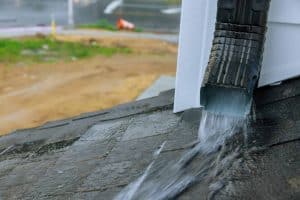
- Check your gutters and downspout splash pads for granule loss. Black, sand-like grit means shingles took a hit even if they’re still in place.
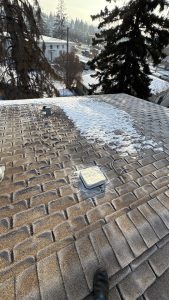
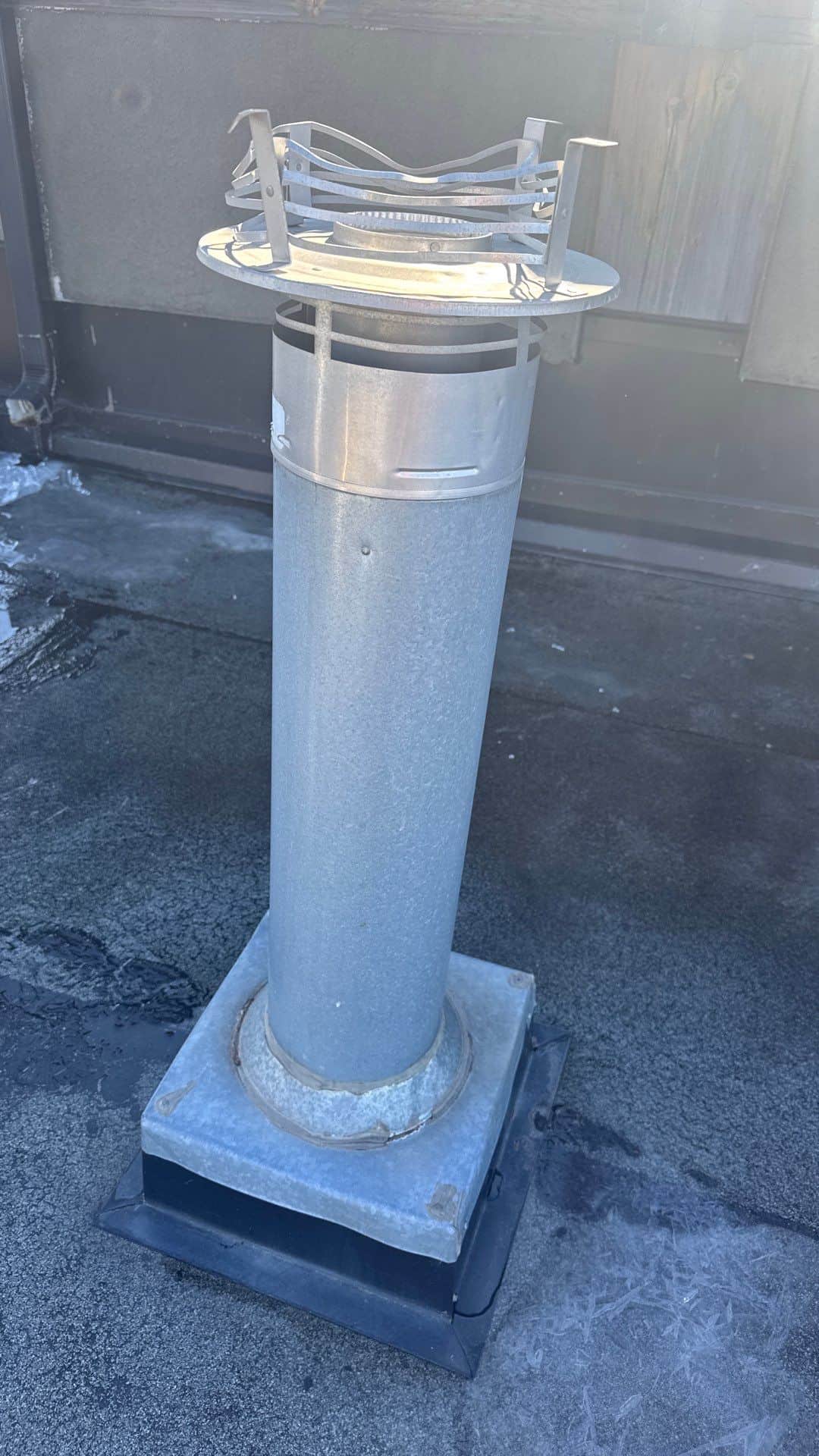
- Look up at the ridges, valleys, and the chimney flashing. These are the spots that fail first in high wind. Binoculars work better than a ladder for a first pass. Pay attention to vent caps and furnace stacks too, which can be pried open or knocked sideways by a strong gust.
- Check the attic. Daylight where there shouldn’t be any, fresh water staining on the sheathing, or shifted insulation are all red flags.
- Document for insurance before any work begins. Date-stamped photos protect your claim. See our Alberta roof insurance guide for what to expect when you file.
- Book a professional inspection if anything looks off. Most wind damage isn’t visible from the ground, and small issues become expensive ones once the next storm rolls in.
Signs Your Roof Needs Repair After a Storm
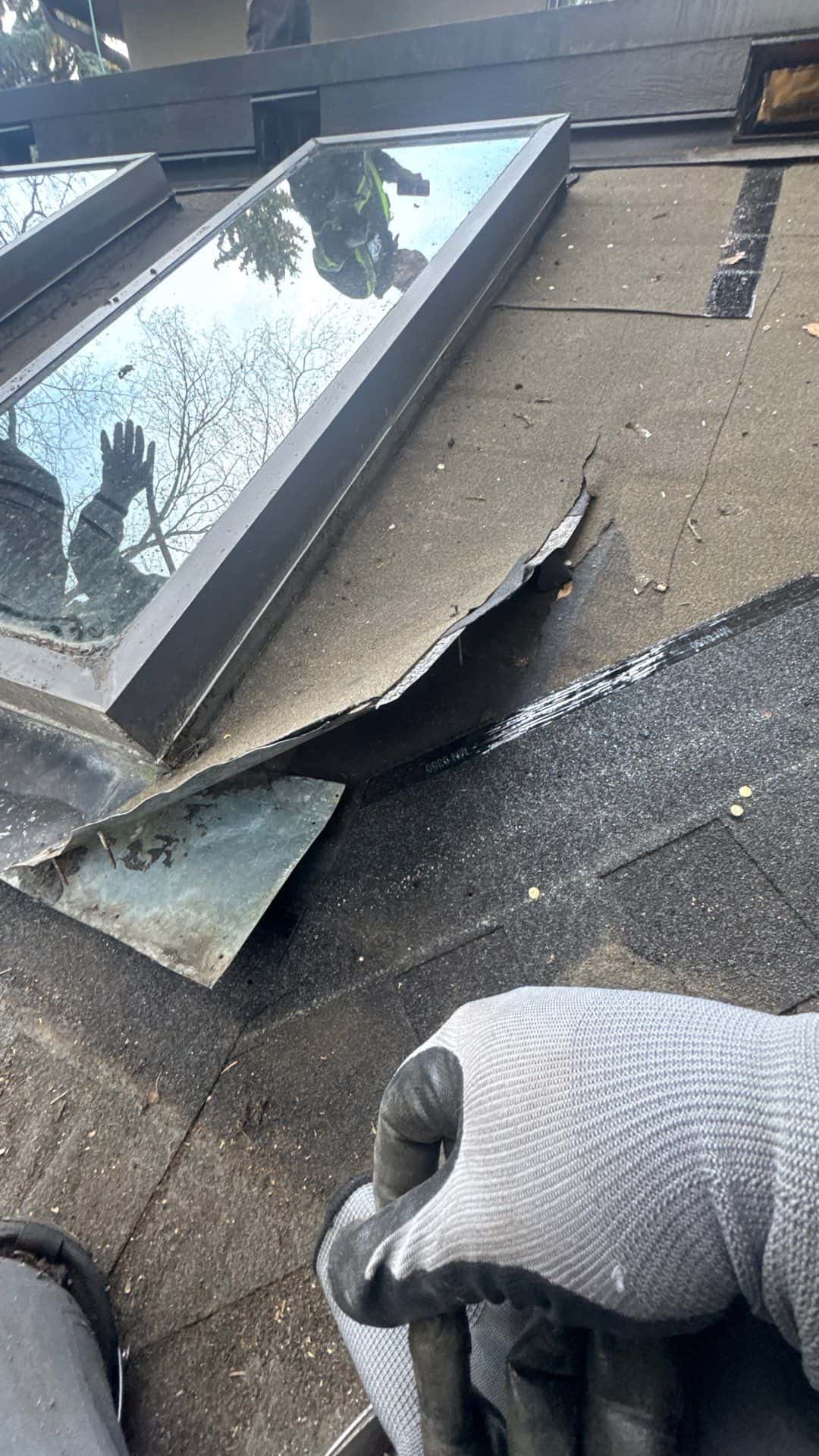
- Broken or missing shingles. If you find a random shingle in your lawn or see where a shingle is missing, you need immediate repair. Strong winds can rip shingles off and leave your home vulnerable to the next rain.
- Curling shingles. Viewed from the ground, the curling up of individual shingle edges is a sign of damage from rapid temperature changes and strong winds.
- Signs of water inside. Water spots on ceilings or interior walls are a sure sign your roof is leaking. This usually means it has been leaking for some time and may require replacement.
- Debris on your roof. Sticks, broken limbs, leaves, or fallen trees on your roof can lead to damage and leaking. Any debris needs to be removed to prevent further damage.
- Loss of shingle granules. High winds can rip asphalt granules from your shingles and deposit them in your gutter. Hail storms are notorious for the same kind of damage. Hail damage is often covered by your insurance, so call us for more information.
When shingles are installed, they’re purposefully overlapped to create a water-tight seal. Lifting and curling can break this seal, leaving your roof vulnerable to wind-driven rain. Major storms can cause trees and other natural debris to fall on your roof, sometimes cracking shingles in ways that aren’t visible until water damage shows up inside the house. If debris is still on your roof after a storm, it’s essential to either check it yourself or call a professional to see whether there is shingle damage underneath.
Watch out for fly-by-night companies that show up after a storm offering a “discounted” roof. An improperly installed roof can take on substantial damage during heavy rain, heavy snow, and the devastating Chinook winds. The price of an improperly installed roof almost always costs more in the long run, even when the initial bid is the lowest. Low-quality installation leads to more repairs and water damage inside the home that ends up doubling the cost of the original “low bid.”

Repair or Replace Your Storm-Damaged Roof in Calgary?
We get that nobody plans for a roof bill. After a storm, our first job is figuring out what your roof actually needs, not what we’d like to sell you. Most wind damage we see can be repaired. If a few shingles are missing, a flashing has lifted, or a ridge cap has loosened, that is straightforward repair work and it is exactly what we do. We will quote the repair, do the repair, and leave it at that.
We will only recommend a full replacement when it is genuinely the right call. That usually means one of two things: your roof is closing in on the end of its 15 to 30 year lifespan, or we are seeing widespread damage and a pattern that tells us more failures are likely after the next storm. In those cases, replacing now usually costs less than chasing repairs over the next two or three years and dealing with the interior damage that follows.
Either way, you will get an honest assessment, photos of what we found, and a clear quote with the options laid out. The decision is yours, and it will be the same decision whether you call us or anyone else worth their salt.
What Makes a Calgary Roof Last in High Wind
Calgary’s wind environment is harder on roofs than most cities in Canada. Chinooks bring sustained gusts, freeze-thaw cycles weaken the sealant strips that hold shingles down, and spring storms like Friday’s stack new damage on top of damage that is already there. A handful of details separate a roof that takes that punishment in stride from one that doesn’t:
- Wind-rated shingles. Different shingle products carry very different wind uplift ratings. Premium architectural shingles are designed to ride out sustained gusts well above the speeds Calgary typically sees, while the cheapest three-tab options top out far lower and are usually the first to lift in a Chinook.
- Fastening matched to wind exposure. Every roof has slopes that catch the prevailing wind harder than others, and edges, ridges, and rake lines that take more punishment than the open field of the roof. The number and placement of fasteners, and where you reinforce or over-fasten, should reflect that. A one-size-fits-all approach is one of the easier ways for a roof to fail early in a Calgary wind.
- Starter strips at the eaves and the rakes. Wind gets under shingles at the edges first. A proper starter strip down both sides, not just the bottom, makes a real difference in a Chinook.
- Synthetic underlayment. Felt underlayment tears in high wind once a shingle lifts. Synthetic holds up and gives you a second line of defence while repairs are scheduled.
- Crews who know Calgary. A roof installed by a crew that has never seen a 40-degree swing in 24 hours behaves differently than one installed by a crew that builds for it. Knowing how Chinook freeze-thaw weakens sealant strips changes how you stage the install, where you over-fasten, and which products you specify.
This is the difference between a roof that needs a few repairs after a 90 km/h storm and one that needs a tarp and an insurance claim. If you are unsure how your current roof was installed, that is exactly the kind of thing a professional inspection will tell you.
Worried About Wind or Storm Damage? Call Us Today.
We offer free onsite estimates, where we come out and inspect your roof for damage and potential leaks. While we are there, we will explain what we found and work with you to develop a roofing solution that fits your budget. You can also learn more about our professional roof inspection service if you want to book one ahead of the next storm.
Whalley’s Four Seasons Roofing guarantees our work, period.
There are some things that today’s inexperienced roofer may miss or fail to consider that end up making the roofing project cost more in the long term. Get the job done right the first time. Become a part of the Whalley’s Four Seasons Roofing difference.